
Support Our Work

Please donate so we can continue our work to reduce the stigma of psychiatric illness, encourage research, and support educational activities for behavioral health professionals and the public. Ways you can donate and help are on our Support and Donations page. Thank you!

More Info

Latest News Around the Web

Switch To Daylight Saving Time May Impact Mental Health

USA Today (3/5, Loehrke) reports the one-hour change amid the transition into daylight saving time “may have an effect on our circadian rhythms, which are the body’s natural 24-hour cycles that regulate essential processes like eating, mood and sleep.” According to USA Today, “the reversal of our biological clocks has been connected to a higher risk of heart attacks, cancer, depression and obesity.” Notably, “the transition from winter to spring can set off mental health problems for many people. About 10% of people” with seasonal affective disorder “have the condition in the spring and summer months.” Additionally, “going to bed later or waking up earlier than usual during the first few days of the time shift could result in sleep deprivation.”

Related Links:

— “For some, the ‘spring forward’ has a cost to their mental health,”Janet Loehrke , USA Today, March 5, 2026

Regular Cannabis Use Related To Increasing Rates Of Poor Mental Health, Study Suggests

HealthDay (3/5, Neff) reports a study found that “as cannabis use becomes more common and weed more potent, the link between the drug and serious mood disorders is intensifying.” The researchers “analyzed data collected from 35,000 Canadians age 15 and older who were surveyed between 2012 to 2022. This timeframe captures the period before and after Canada legalized recreational cannabis in 2018.” The study “highlights a troubling trend: Cannabis use and mental health struggles are increasingly appearing together. While the study does not definitively prove that one causes the other, the statistical overlap is hard to ignore.” For example, researchers noted that “reports of generalized anxiety disorder and major depression nearly doubled, affecting 5.2% and 7.6% of the population, respectively.” Going forward, “researchers are calling for mental health [professionals] to routinely screen for cannabis use.” The study was published in The Canadian Journal of Psychiatry.

Related Links:

— “Study Links Rising Cannabis Use to Poor Mental Health,”Deanna Neff, HealthDay, March 5, 2026

Disenrollment From Health Plans Associated With Increased Risk Of All-Cause, Overdose Mortality Among Patients Who Initiated Medications For OUD, Study Finds

MedPage Today (3/4, Firth) reports a study found that “disenrollment from health plans was associated with an increased risk of mortality among patients who initiated medications for opioid use disorder (OUD).” Researchers observed that “in adjusted analyses of more than 20,000 patients, ever experiencing disenrollment was associated with increased risks of all-cause mortality (HR 1.51) and overdose mortality (HR 1.56).” Furthermore, “the all-cause mortality rates were 17.6 versus 14.7 per 1,000 person-years for patients with and without health plan disenrollment, respectively, while rates of overdose mortality were 8.9 versus 5.4 per 1,000 person-years.” The study was published in JAMA Psychiatry.

Related Links:

MedPage Today (requires login and subscription)

GLP-1 Medications May Help Prevent Multiple Substance Use Disorders, Research Finds

The AP (3/4, Aleccia) reports that “GLP-1 drugs…may help prevent multiple substance use disorders – and reduce the tragic outcomes they cause, a large new study finds.” Investigators “looked at electronic health records from more than 600,000 U.S. Veterans Affairs patients with diabetes.” The researchers “found that those treated with” GLP-1 “medications…were less likely to develop addictions to alcohol, nicotine, cocaine, opioids and other substances than those treated with a different class of drugs.” Among “those already addicted, the GLP-1 drugs were linked to lower risks of hospitalization, overdose and death, according to the study.” The findings were published in The BMJ.

Among other sources covering the story are Reuters (3/4, Lapid) and NBC News (3/4, Sullivan).

Related Links:

— “What to know about how GLP-1 medications might fight addiction,” Jonel Aleccia , AP , March 4, 2026

ChatGPT health frequently underestimates severity of medical emergencies

NBC News (3/3, Ozcan) reports a study found that OpenAI’s ChatGPT Health “frequently underestimated the severity of medical emergencies.” For the study, “researchers tested ChatGPT Health’s ability to triage, or assess the severity of, medical cases based on real-life scenarios.” The researchers “fed 60 medical scenarios to ChatGPT Health. The chatbot’s responses were compared with the responses of three physicians who also reviewed the scenarios and triaged each one based on medical guidelines and clinical expertise.” They observed that “ChatGPT Health ‘under-triaged’ 51.6% of emergency cases. That is, instead of recommending the patient go to the emergency room, the bot recommended seeing a doctor within 24 to 48 hours.” In addition, “compared with the doctors in the study, the bot also over-triaged 64.8% of nonurgent cases, recommending a doctor’s appointment when it wasn’t necessary.” The study was published in Nature Medicine.

Related Links:

— “ChatGPT Health ‘under-triaged’ half of medical emergencies in a new study,”Kaan Ozcan, NBC News, March 3, 2026

Foundation News

New Radio PSA Examines Rise in Child Suicides

Suicide rates among those under age 25 increased 56% in the last decade and tripled for 10 to 14 year olds. Getting professional help is important for the health of the child.

The Suicide Epidemic Among ChildrenThe Suicide Epidemic Among Children, MP3, 3.2MB

You can listen to the ad using the player in the upper right of the website’s homepage. All past public service spots are also available for listening or to download on our Radio Advertisements page.

Foundation Chosen as Community Partner by Maryland Aviation Administration

The Maryland Foundation for Psychiatry was selected by the Maryland Aviation Administration Community Partners Program to display a poster in the terminal at BWI Thurgood Marshall Airport. It can be found on Concourse C, between Gates C-4 and C-6, on the secure side for the next six months.
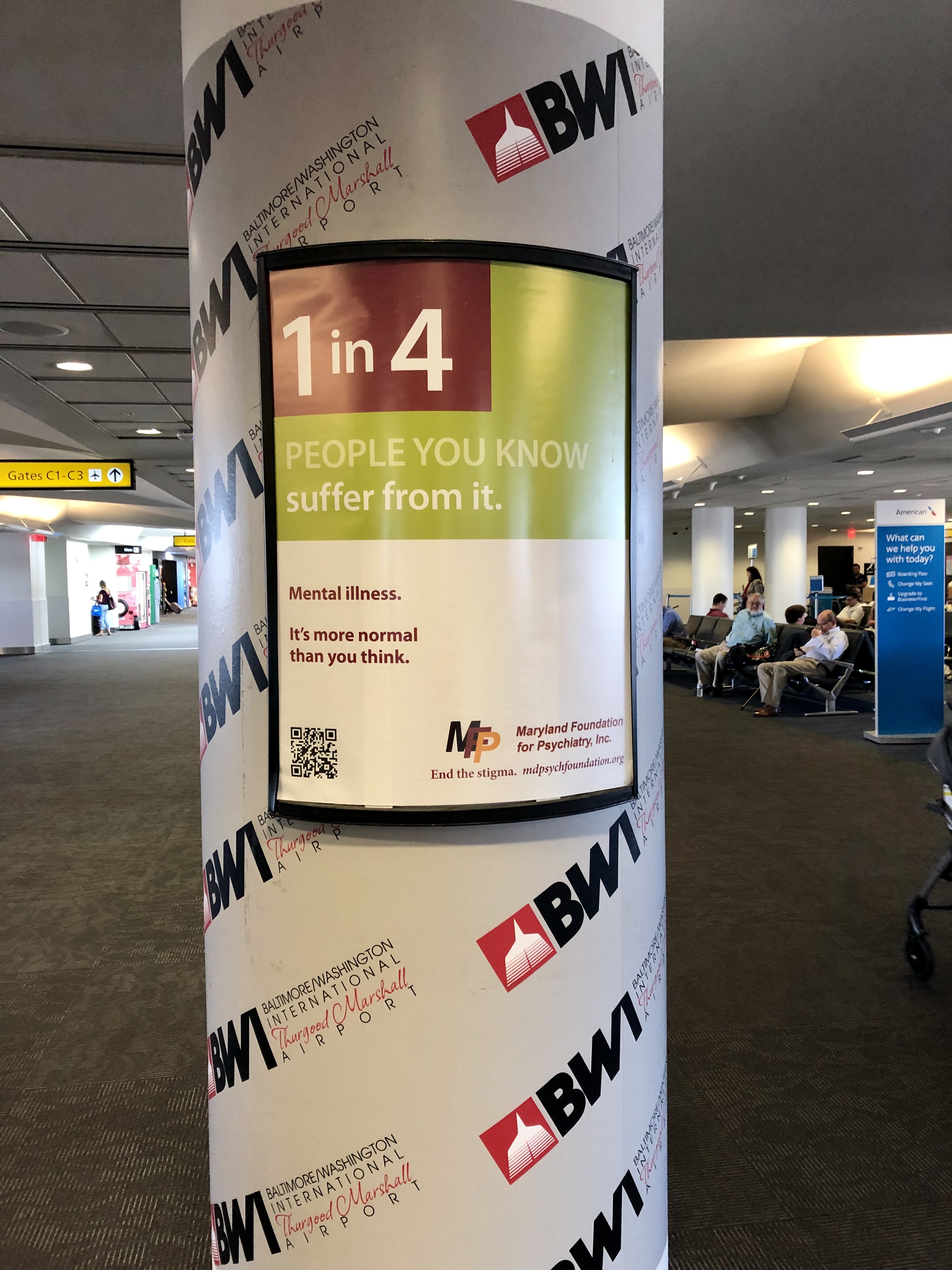
 

Maryland Foundation for Psychiatry Community Partner Poster

(Select to view larger image)

New Radio Ad Examines Suicidal Risk in Children

About a third of children who show up in emergency rooms have risk factors for suicide. A new public service ad by the Foundation examines how critical it is to screen adolescents and lists warning signs. Getting professional help is important for the health of the child.

Suicidal Risk in ChildrenSuicidal Risk in Children, MP3, 2.5MB

You can listen to the ad using the player in the upper right of the website’s homepage. All past public service spots are also available for listening or to download on our Radio Advertisements page.

New Radio Ad Examines Affects of Shootings on Communities

Gun violence affects an entire community’s mental health. A new public service ad by the Foundation explores how shootings traumatize the victim, the witnesses, and family members. Having someone to talk to, particularly a psychiatrist, can help cope.

Shootings and CommunitiesShootings and Communities, MP3, 2.5MB

You can listen to the ad using the player in the upper right of the website’s homepage. All past public service spots are also available for listening or to download on our Radio Advertisements page.