
Support Our Work

Please donate so we can continue our work to reduce the stigma of psychiatric illness, encourage research, and support educational activities for behavioral health professionals and the public. Ways you can donate and help are on our Support and Donations page. Thank you!

More Info

Latest News Around the Web

People reporting high level of loneliness have elevated risk for developing valvular heart disease

Healio (4/15, Swain) reports, “People reporting a high level of loneliness, but not those with social isolation, had elevated risk for developing valvular heart disease, according to the results of a prospective cohort study.” One researcher said, “Our findings suggest that loneliness may be an independent and potentially modifiable risk factor for degenerative valvular heart disease. Identifying this new risk is an important step in potentially preventing valve disease, which can lead to heart failure, reduced quality of life and the need for valve replacement surgery.” The findings were published in the Journal of the American Heart Association.

Related Links:

— “Loneliness tied to elevated risk for valvular heart disease,”Erik Swain, Healio, April 15, 2026

Mental Health Parity Index Finds Patients Across US Face Greater Barriers To Accessing MH/SUD Care Compared With Physical Care

Psychiatric News (4/15) reports the latest Mental Heath Parity Index “starkly illustrates how patients across the country face greater barriers to accessing mental health/substance use disorder (MH/SUD) care compared with physical health care – even though Congress requires insurers to treat the two equally.” The index “compares network composition and reimbursement rates for MH/SUD services and physical health services among the nation’s four largest insurers: Aetna, BlueCross BlueShield, Cigna, and UnitedHealthcare.” This year’s edition found that “in 42 states plus Washington, D.C., patients face a greater disparity in accessing in-network MH/SUD services compared with physical health services. Nationally, UnitedHealthcare has the greatest discrepancy, with 48% of the nation’s physical [healthcare professionals] in its network, compared with only 20% of MH/SUD” healthcare professionals.

Related Links:

— “Patients in Almost Every State Face Disparities in Accessing Mental Health Care, Psychiatric News, April 15, 2026

Research examines impact of cannabis on brain

The Washington Post (4/14, Klein) reports on how cannabis impacts the brain, saying it “can affect your ability to retain information in the short term.” In a study published in JAMA Network Open, heavy lifetime cannabis “users exhibited lower brain activity during a working memory task compared with nonusers after excluding recent users.” Additionally, long-term cannabis use has “been associated with changes in brain volume,” especially “in people who started using cannabis in adolescence, when the brain was still developing.” Meanwhile, in a review published in The Lancet Psychiatry, “researchers found no help or harm from specific cannabinoids with relation to a number of mood-related concerns.” The review “also concluded there wasn’t enough data to study any potential effects on bipolar disorder or depression.”

Related Links:

— “The Washington Post (requires login and subscription)

Prenatal Maternal Smoking Exposure Tied To Behavioral, Mental Health Challenges In Offspring, Study Suggests

HealthDay (4/14, Solomon) reports a study found that “children exposed to prenatal maternal smoking are more likely to experience behavioral and mental health challenges.” The researchers observed that “maternal tobacco smoking during pregnancy predicted differentiation toward externalizing problems in children aged 1 to 2 years through 7 to 8 years and children aged 13 to 14 years. Effects were similar for boys and girls. Across all ages, maternal tobacco smoking during pregnancy predicted higher symptom severity.” The researchers noted that “prenatal smoking exposure was also associated with a greater likelihood of having multiple mental health or behavioral symptoms.” The study was published in Development and Psychopathology.

Related Links:

— “Prenatal Maternal Smoking Linked to Behavioral Health Challenges in Offspring,”Lori Solomon, HealthDay, April 14, 2026

Rise In Gambling Addiction Outpaces Public Health Response, Experts Warn

Fierce Healthcare (4/14, Gliadkovskaya) reports the surge in “all gaming segments,” including casinos, sports betting, online games, and prediction markets, is “creating an addiction crisis yet to be widely recognized by the public, policymakers and the healthcare sector, experts caution. Current national problem gambling prevalence is unknown due to a lack of research and funding dedicated to the issue.” Experts believe “those most at risk include young adults, men and online gamblers. Gambling-related harms can be dire, from financial stress to co-occurring behavioral health conditions to suicide, which a fifth of individuals with gambling addiction attempt.” Fierce Healthcare “talked to two dozen [healthcare professionals], researchers, advocates and regulators” about “problem gambling, what’s driving it and efforts underway to address it.” Regardless of the true prevalence of gambling disorder, “a fraction of cases actually show up in clinical settings,” as “most [healthcare professionals] are not screening for problem gambling, much less diagnosing gambling disorder.” Notably, “federal funding for gambling disorder has been all but nonexistent,” meaning that “prevention and treatment, like legalization, has thus far been up to states.”

Related Links:

— “‘The next opioid epidemic’: Gambling legalization outpaces public health response to addiction,”Anastassia Gliadkovskaya, Fierce Healthcare, April 14, 2026

Foundation News

New Radio PSA Examines Rise in Child Suicides

Suicide rates among those under age 25 increased 56% in the last decade and tripled for 10 to 14 year olds. Getting professional help is important for the health of the child.

The Suicide Epidemic Among ChildrenThe Suicide Epidemic Among Children, MP3, 3.2MB

You can listen to the ad using the player in the upper right of the website’s homepage. All past public service spots are also available for listening or to download on our Radio Advertisements page.

Foundation Chosen as Community Partner by Maryland Aviation Administration

The Maryland Foundation for Psychiatry was selected by the Maryland Aviation Administration Community Partners Program to display a poster in the terminal at BWI Thurgood Marshall Airport. It can be found on Concourse C, between Gates C-4 and C-6, on the secure side for the next six months.
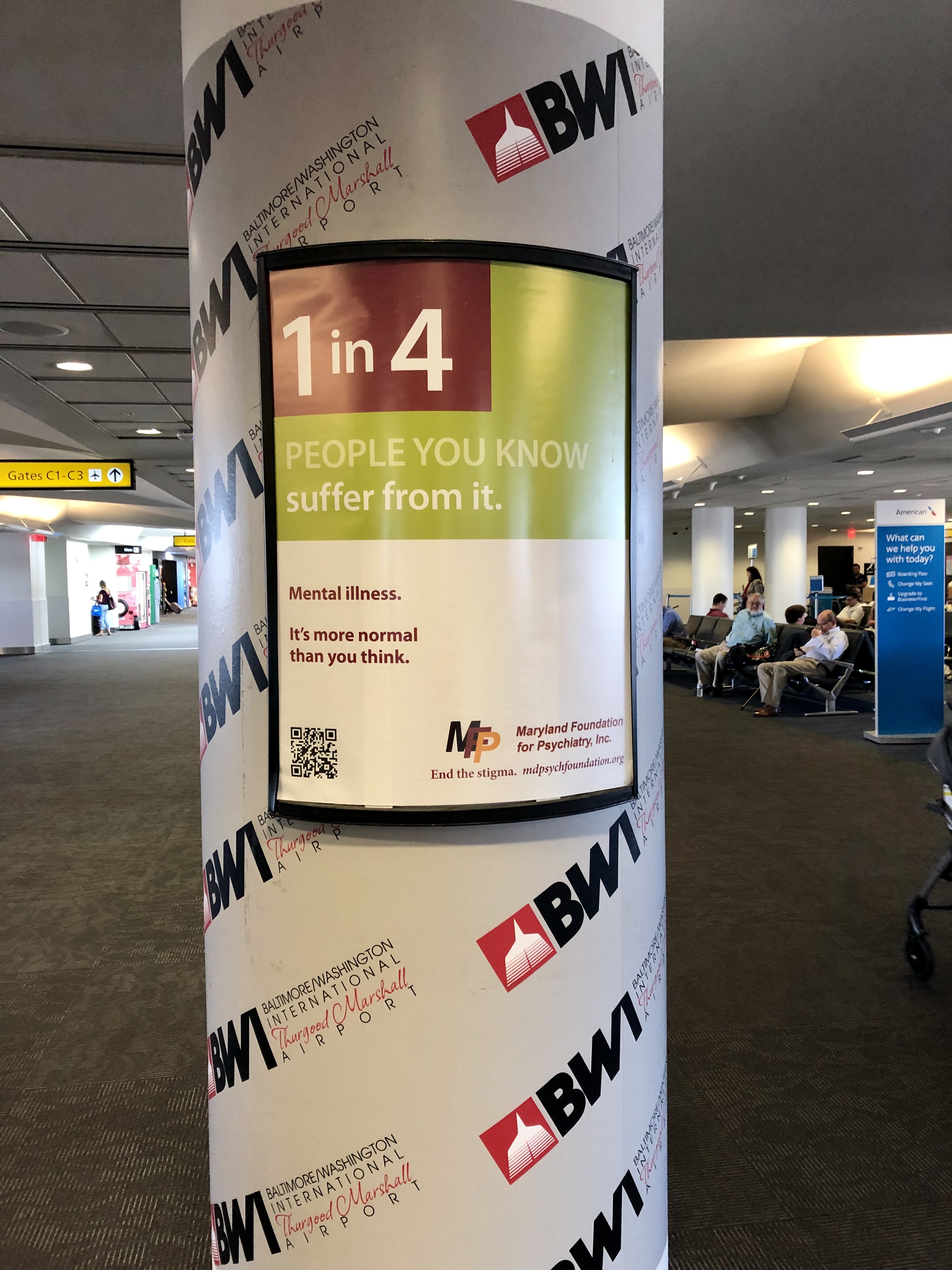
 

Maryland Foundation for Psychiatry Community Partner Poster

(Select to view larger image)

New Radio Ad Examines Suicidal Risk in Children

About a third of children who show up in emergency rooms have risk factors for suicide. A new public service ad by the Foundation examines how critical it is to screen adolescents and lists warning signs. Getting professional help is important for the health of the child.

Suicidal Risk in ChildrenSuicidal Risk in Children, MP3, 2.5MB

You can listen to the ad using the player in the upper right of the website’s homepage. All past public service spots are also available for listening or to download on our Radio Advertisements page.

New Radio Ad Examines Affects of Shootings on Communities

Gun violence affects an entire community’s mental health. A new public service ad by the Foundation explores how shootings traumatize the victim, the witnesses, and family members. Having someone to talk to, particularly a psychiatrist, can help cope.

Shootings and CommunitiesShootings and Communities, MP3, 2.5MB

You can listen to the ad using the player in the upper right of the website’s homepage. All past public service spots are also available for listening or to download on our Radio Advertisements page.